What Is a Kink? A Clear, Judgment-Free Explanation
Adults 18+ · Educational content, not medical or psychological advice
By KinkWeave Editorial ·
A kink is an interest, fantasy, or preference that someone experiences as outside conventional expectations around sexuality or intimacy. The term is broad and informal. It can describe a particular theme, a preferred dynamic, or something a person enjoys imagining. Having a kink does not automatically mean acting on it, adopting an identity, or having a psychological disorder.
If you are wondering “what is a kink?” because the word keeps appearing online, you do not need a dramatic example to understand it.
Start with a simpler question: what kinds of attention, atmosphere, language, or agreed interaction feel meaningful to you?
The answer may involve kink, or it may not. Either is a reasonable starting point.
What is a kink? A plain-language definition
“Kink” is an umbrella term rather than a precise diagnostic category.
People use it to discuss interests that depart from what they or their communities consider conventional. That makes the word useful for conversation but imperfect for drawing universal boundaries. The general terminology is summarized in Kink (sexuality).
A person might use the word confidently, tentatively, humorously, or not at all. You do not need to choose the same label for yourself that someone else would choose for you.
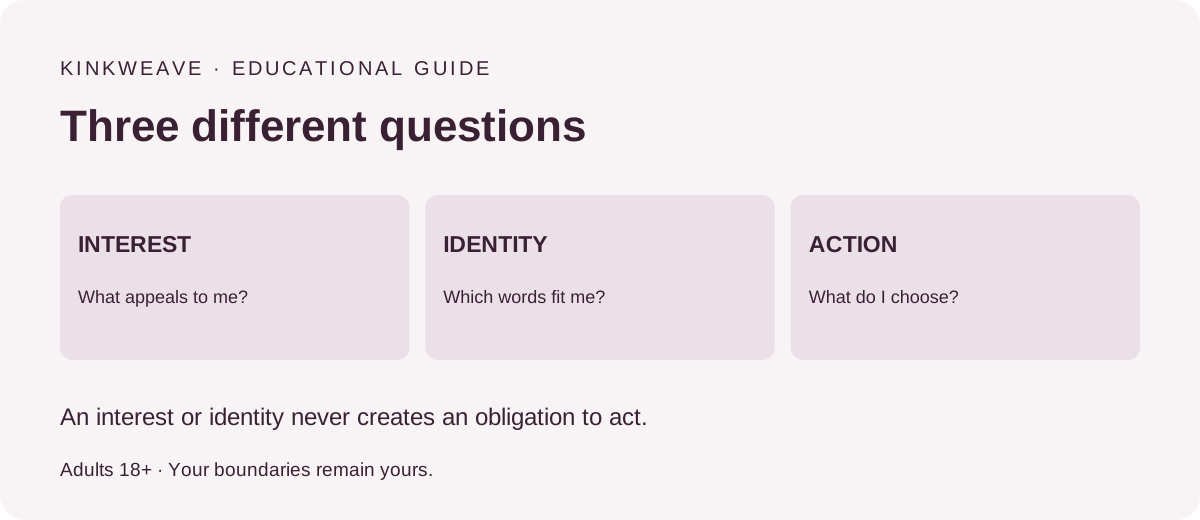
Interest, identity, and behavior are different
An interest is something that catches your attention or appeals to you.
An identity is a word you choose to describe yourself.
A behavior is something you actually do.
These can overlap, but none automatically establishes the others.
For example, someone can be curious about a fictional role without wanting to enact it. Someone else may enjoy a particular kind of communication without identifying as kinky.
A third person may use a kink label as an important part of their identity while keeping most of that life private.
This distinction helps prevent a common misunderstanding: discovering a word does not create an obligation to live up to it.
“Unconventional” depends on context
There is no single border separating conventional intimacy from kink for every person.
A particular interest may seem familiar in one community and unfamiliar in another. Language also changes over time.
Rather than arguing over whether a preference is “kinky enough,” ask whether the word helps describe it.
If a label adds clarity, it may be useful. If it creates expectations you do not share, ordinary language may work better.
“I like clear guidance” or “I enjoy sincere compliments in private” can communicate more than a label whose meaning both people interpret differently.
The point is mutual understanding, not passing a vocabulary test.
Kink vs. fetish: what is the difference?
In everyday use, kink is usually the broader term. Fetish often refers to a more specific focus of sexual interest, such as an object, material, or body part.
People sometimes use the words interchangeably, so the distinction is a guide rather than a rule that everyone follows.
| Question | Kink | Fetish |
|---|---|---|
| How broad is the term? | Broad umbrella for interests, fantasies, and dynamics | Often a more specific focus of interest |
| What might it emphasize? | A theme, interaction, role, atmosphere, or preference | A particular object, material, or body part |
| Does it automatically describe behavior? | No | No |
| Does it automatically mean a disorder? | No | No |
| Does it automatically establish consent? | No | No |
| What is the best clarification? | “What does that interest mean to you?” | “How does that particular focus matter to you?” |
A common shortcut says a kink is optional while a fetish is always necessary for arousal. That is too absolute for ordinary conversation.
A specific focus may be central for one person and less central for another. You cannot determine its importance from the word alone.
Clinical terminology has a narrower purpose than casual self-description. Avoid taking a dictionary label and using it to diagnose yourself or a partner.
If the practical question is compatibility, discuss what the interest means in everyday life. How important is it? Is it fantasy-only? Does the person want to share it, keep it private, or simply have it understood?
Those answers are more useful than debating which noun is technically correct.
Is kink the same as BDSM?
The terms overlap, but they are not identical.
BDSM commonly refers to bondage and discipline, dominance and submission, and sadism and masochism. Kink is a broader umbrella that may include some of these interests and other themes.
A person who enjoys affirming language does not necessarily enjoy a power dynamic. Someone interested in roleplay does not necessarily want restraint or intense sensation.
BDSM is also not a single package. Interest in one element does not imply agreement to the others.
In this guide, any discussion of BDSM participation assumes consenting adults, explicit boundaries, an agreed safeword or stop signal, and consideration of SSC or RACK. Those conditions belong before activity, not after it.
For a category-by-category explanation, see types of kinks.
Why people have kinks: psychology and research
“Kink psychology” is a useful search phrase, but it can produce explanations that are much more certain than the evidence.
A careful answer distinguishes research about groups from explanations about one individual.
Research does not establish one universal cause
A 2019 systematic review by De Neef and colleagues examined BDSM through biological, psychological, and social perspectives. The authors noted that much of the available research was descriptive, with relatively little directly testing underlying mechanisms.
A scoping review by Brown, Barker, and Rahman likewise considered multiple dimensions of BDSM research rather than reducing it to one cause.
These reviews do not provide a formula that can explain why you have one particular preference.
A group-level association cannot establish what caused an individual’s interest. It also cannot predict whether a fantasy will remain appealing, change, or matter in a future relationship.
An interest is not automatically a disorder
The American Psychiatric Association distinguishes atypical sexual interests from paraphilic disorders. An unusual interest alone is insufficient for a diagnosis; clinically relevant distress and harm-related criteria matter. Its DSM explanation specifically addresses this distinction.
That does not mean every behavior is harmless. It means a label such as “kink” cannot, by itself, establish pathology.
Questions about consent, well-being, and the effects of behavior deserve attention on their own terms.
Be careful with explanations that sound too neat
Be skeptical of claims such as:
- “This interest proves you experienced a particular kind of childhood.”
- “People who enjoy this always have one attachment style.”
- “A quiz can identify the hidden trauma behind your preferences.”
- “One brain chemical explains every kink.”
These statements compress complicated questions into a story that may feel convincing without being established.
You do not need a complete origin story to communicate a current preference.
If a preference causes distress or interferes with life, a qualified professional can help explore the concern without assuming that the interest itself must be eliminated.
Seeking support and rejecting stigma are compatible choices.
Common categories of kinks
Categories are useful for organizing vocabulary, but they overlap. They should not be treated as fixed personality types.
Sensory interests concern the importance of texture, sound, atmosphere, or other sensory qualities. The appealing detail may be subtle rather than intense.
Roleplay interests concern a fictional setting or character. What matters may be storytelling, humor, novelty, or a temporary change of perspective.
Power-related interests concern an agreed dynamic of leading, following, or exchanging control within defined limits. A role in one context does not determine a person’s personality elsewhere.
Language and affirmation interests concern the emotional or intimate significance of words. The meaning, speaker, and setting can matter as much as the wording.
Object or material interests concern a particular focus, such as a fabric or style. These may overlap with what someone calls a fetish.
For a quieter introduction to preference language, KinkWeave’s kink list presents broad themes rather than an activity menu.
One example worth understanding separately is a praise kink. Enjoying praise can be about specific language and context; it does not automatically imply submission or interest in other categories.
How to understand your own preferences
Begin with description before classification.
Instead of asking, “Which type am I?” try asking, “What part of this idea appeals to me?”
You might notice that the appeal comes from being listened to, knowing what to expect, enjoying imaginative conversation, or receiving undivided attention.
These observations are more specific than a label and easier to discuss.
Next, separate curiosity from willingness. A private reflection can use four simple categories:
| Response | Meaning |
|---|---|
| Interested in learning | I want more information |
| Appealing in imagination | I enjoy the idea without committing to action |
| Possibly open to discussing | I might consider a conversation under the right conditions |
| Not for me | I do not want to pursue it |
These categories are not stages to progress through. “Appealing in imagination” can remain the final answer.
You can also be uncertain. Uncertainty does not require immediate testing through experience.
Notice whether you feel free to keep the preference private. If exploring a topic starts to feel like performing an identity for other people, take a step back and return to your own words.
How to talk about kinks with a partner
A conversation works best when the invitation is clear and the answer can be honest.
You do not need a polished explanation or a label with perfect precision.
Ask whether the conversation is welcome
Choose a calm moment and begin with permission to discuss the topic.
For example:
“I’ve been reading about preferences and found something I’d like to talk about. Is now a comfortable time?”
This gives the other person a choice about timing and attention.
Avoid introducing a new idea as though participation has already been decided. “I want to explain something” and “I want us to do something” are different requests.
If you are only looking for understanding, say that directly.
Describe the meaning, not just the label
A useful explanation includes the part that appeals to you and the parts you do not mean.
For example:
“I like encouraging language in private. I’m not asking for a role or a whole new dynamic.”
Or:
“I enjoy the idea of agreed structure, but I do not want decisions made for me outside that context.”
The label can come afterward, if it helps.
Ask the other person what they heard. Clarifying a mismatch early is easier than discovering later that both people agreed to different ideas.
Leave room for different answers
A partner may understand you and still not share the interest.
Try to distinguish rejection of a proposal from rejection of you as a person.
You can ask whether there is a smaller area of genuine overlap, but do not treat negotiation as a campaign to overcome a clear boundary.
A respectful response to “no” might be: “Thanks for telling me. I’m glad we can talk honestly.”
Both people’s limits matter. Neither person must become more adventurous, more conventional, or more articulate to deserve respect.
Consent and safety belong in the definition of exploration
Curiosity is personal. Shared activity requires an agreement.
For BDSM-related exploration, that agreement should include boundaries, a usable safeword or stop signal, and explicit discussion of risks through a framework such as SSC—safe, sane, and consensual—or RACK—risk-aware consensual kink.
Neither phrase guarantees safety.
The NCSF consent resources provide further education on prior permission, communication, and recognizing violations.
One useful principle is to keep consent specific. Agreement to conversation is not agreement to touch. Agreement to one interaction does not authorize another. A relationship, identity, or past experience does not supply missing permission.
Everyone must also remain free to pause without having to protect someone else’s feelings first.
If an idea involves fictional resistance, start with the separate guide to CNC kink meaning. The terminology can be confusing, and actual withdrawal of consent must remain effective.
What a kink test can and cannot tell you
A questionnaire can give you prompts you would not have thought to ask yourself. It can also provide vocabulary for patterns in your answers.
It cannot tell you what you must want.
Treat a result as a draft description: useful where it fits, disposable where it does not.
A high score on a theme is not proof of experience, readiness, or compatibility. A low score is not a limitation to overcome.
If a question feels unclear, uncertainty is more informative than selecting the answer that seems to match an identity.
You can explore the kink test and its scoring explanation to understand what the tool is designed to describe.
Afterward, consider writing one sentence without using any test label: “One thing I noticed is that I prefer…”
That sentence may be more useful in a conversation than the score itself.
You also do not have to take a test. Reading, thinking, and deciding that a topic is not relevant to you are complete ways of engaging with it.
What matters is having language that helps you understand yourself while leaving your choices open.
Frequently asked questions
Is having a kink a mental illness?
An interest alone is not a diagnosis. Clinical assessment considers factors such as distress, impairment, and harm; a kink label cannot establish a mental illness.
Can I have a kink without trying it?
Yes. An interest or fantasy does not require action. You can keep it private, discuss it, or decide not to pursue it.
Does enjoying kink mean I am submissive?
No. Kink includes many different interests. Enjoying one theme does not establish a role, identity, or preference for a power dynamic.