Types of Kinks Explained: Meaning, Examples, and Boundaries
Adults 18+ · Educational content, not medical or psychological advice
By KinkWeave Editorial ·
Types of kinks can be grouped by what someone finds appealing: sensation, fictional roles, agreed power dynamics, restraint, particular materials or objects, and language or attention. These categories overlap. They describe possible interests, not a set of experiences to collect or a system for assigning people permanent identities.
If you have encountered a long glossary, the sheer number of terms can obscure the useful question: what does each category actually mean?
This guide explains broad categories with non-graphic examples and a safety consideration for each. It is an introduction to vocabulary, not an instruction manual.
For the broader definition, begin with what is a kink?.
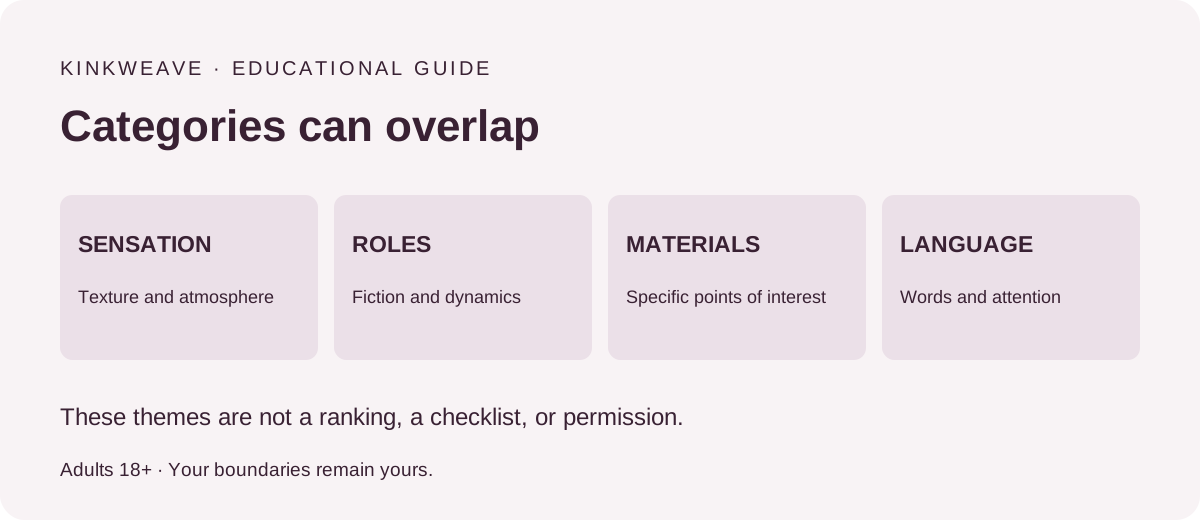
How kinks are categorized
There is no single, universal classification that divides every interest into neat boxes.
A category may describe the focus of attention, such as texture. Another may describe an interaction, such as agreed leadership. A third may describe a fictional frame, such as roleplay.
Those are different dimensions, so overlap is expected.
Categories describe interests, not fixed identities
Imagine someone who likes a carefully planned evening, sincere encouragement, and a particular fabric.
Those preferences could touch structure, language, and sensory interests. They do not automatically establish a BDSM role or mean the person identifies as kinky.
Likewise, knowing one person enjoys a category tells you little about which examples within it they welcome.
A category is a starting point for questions. It is not a shortcut around asking them.
KinkWeave’s list of kinks approaches the subject through six broad preference themes. It is useful for descriptive language rather than as an exhaustive catalog of activities.
Start with the consent framework
Every BDSM-related example below assumes consenting adults, explicit boundaries, an agreed safeword or stop signal, and consideration of SSC—safe, sane, and consensual—or RACK—risk-aware consensual kink.
SSC emphasizes safety, informed decision-making, and consent. RACK makes risk awareness explicit. Neither makes a category risk-free; both are discussed in the consent terminology overview.
The safety notes below identify concerns to discuss. They do not provide enough information to perform an activity safely.
If a person is uncertain, reluctant, or unable to communicate a free choice, a category description does not supply the missing agreement.
Types of kinks at a glance
This table summarizes the categories explained below.
| Category | Main focus | Non-graphic example | Boundary or safety question |
|---|---|---|---|
| Sensory interests | Texture, sound, atmosphere, or other sensations | A preference for a particular fabric or setting | Which sensations are welcome or unwelcome? |
| Impact-related interests | Consensually negotiated impact sensations | An interest in impact as a concept | What expertise and risk assessment are missing? |
| Roleplay | An agreed fictional scenario or character | A scripted interaction between adult characters | Which themes and words are excluded? |
| Power dynamics | Agreed leading, following, or exchanging control | One person guiding a defined interaction | Where does the role begin and end? |
| Structure and ritual | Predictability and repeated agreed patterns | A mutually chosen opening or closing ritual | Can the routine be declined without consequences? |
| Restraint and bondage | Restricted movement or its symbolism | Interest in the concept or visual aesthetic | How are communication and prompt release preserved? |
| Materials and clothing | A particular sensory or visual focus | Interest in a fabric, style, or garment | Is wearing or touching it actually welcome? |
| Objects or body-part interests | A specific focus of attention | An interest in footwear or feet | Has the individual agreed to that attention? |
| Language and praise | Words, tone, recognition, or affirmation | A welcome private compliment | Which wording feels good, and which does not? |
No row is a prerequisite for another. There is no need to move downward through the table.
Sensation and impact play
These categories are sometimes grouped together because both concern physical sensation. That grouping should not obscure their differences.
Enjoying a texture does not imply interest in impact, and a general “sensation” label does not specify intensity.
Sensory interests
Meaning: Sensory interests place special importance on what an interaction feels, sounds, or looks like. The appeal may come from a particular quality or atmosphere rather than a role.
Examples: Someone may be drawn to soft fabric, a calm environment, a familiar sound, or the contrast between different textures. A preference can be entirely about comfort and attention.
Safety note: Ask about sensory dislikes and sensitivities explicitly; something described as gentle or soothing may still be unwelcome to another person.
A useful clarification is, “What part of the sensation matters?” The answer might be predictability, softness, novelty, or the ability to control the setting.
Avoid using “sensory” as a catch-all permission for experiments. Naming one welcome sensation does not authorize others.
Impact-related interests
Meaning: Impact-related interests concern consensually negotiated impact sensations or their symbolism. They belong to a distinct discussion of risk, boundaries, and competence.
Examples: A person might be curious about the concept, identify with a particular role in fiction, or want to understand the terminology without participating.
Safety note: Consent and a safeword are necessary foundations but do not replace activity-specific education or eliminate injury risk.
This article intentionally does not provide techniques, intensity suggestions, or body-area guidance.
The important interpretive point is that “likes sensation” and “wants impact” are not interchangeable statements. If someone uses either phrase, clarify it in ordinary language.
No one needs to test the category to decide that it is not for them.
Roleplay and power dynamics
These interests can overlap, but fiction and power exchange are not the same thing.
Someone may enjoy a fictional character without wanting another person to make decisions for them. Someone else may enjoy agreed guidance without any fictional story.
Roleplay
Meaning: Roleplay introduces an agreed fictional frame, setting, or character into an interaction. The appeal may involve imagination, playfulness, or trying a different perspective.
Examples: Two adults might enjoy inventing fictional characters, using a themed conversation, or discussing a story that remains entirely imaginary.
Safety note: Agree on excluded themes and a clear way to leave the fictional frame; consent to a story does not authorize unplanned behavior.
Ask whether the person likes creating the story, inhabiting a character, or simply hearing about an idea.
Those are different preferences, and the distinction can prevent a conversation from becoming a proposal someone never intended.
Dominance, submission, and switching
Meaning: These terms can describe consensually agreed leading and following roles. “Switching” can refer to interest in more than one role, depending on the person or context.
Examples: One adult may enjoy guiding a defined interaction while another enjoys receiving that guidance. Both remain able to reject a suggestion or end the arrangement.
Safety note: Specify the scope and duration of any role; authority in one agreed context does not extend to someone’s entire life.
A person’s everyday confidence, career, or social style does not tell you which role they prefer.
Nor does a preferred role tell you which activities they welcome.
If the discussion turns to fictional resistance, read the separate explanation of CNC kink meaning. It requires particular care around the difference between a fictional scenario and actual, continuing consent.
Structure and ritual
Meaning: Structure-related interests concern clear expectations, repeated patterns, or mutually chosen rituals. The appeal may be knowing what comes next.
Examples: A person might like an agreed check-in phrase, a predictable conversation format, or a familiar way of marking the end of a shared interaction.
Safety note: A routine must remain optional; missing or declining it should not become grounds for pressure or punishment outside a freely agreed context.
Structure can also be entirely non-kinky. The same behavior may carry different meaning for different people.
Ask whether the important element is predictability, symbolism, reassurance, or something else.
Restraint and bondage
Meaning: This category concerns restricted movement, its visual presentation, or the symbolic idea of restraint. Interest may be physical, aesthetic, imaginary, or some combination.
Examples: Someone may like the visual language of a design, be curious about the symbolism, or enjoy reading about the topic without wanting any restriction of movement.
Safety note: Physical restraint introduces risks that a general article cannot adequately address; it requires specific education, clear communication, and a reliable plan for prompt release.
Do not interpret enthusiasm about an image as permission for an activity.
It is also important to distinguish the appeal from the method. Someone might be interested in the idea of surrender but have no interest in being physically restricted.
That person does not need to override the boundary to make the preference “count.”
Within an SSC or RACK discussion, ask what remains unknown. If participants cannot explain the risks or preserve effective stopping and communication, the vocabulary has moved ahead of the preparation.
A label is never a substitute for competence.
Fetish-adjacent interests
“Fetish-adjacent” is used here as an editorial grouping, not a clinical category.
It covers specific materials, objects, or body-part interests that people may describe with different words. Whether someone calls an interest a kink, fetish, or preference is something to ask them.
Materials and clothing
Meaning: The focus is a particular material, garment, visual style, or sensory quality. What appeals may be the texture, appearance, symbolism, or personal association.
Examples: Someone might have a particular interest in leather styling, satin, footwear, or a formal outfit. The same item can have entirely ordinary meaning for another person.
Safety note: Wearing something is not permission to be touched, photographed, or approached sexually; ask about the specific attention being proposed.
A useful question is whether the interest is primarily visual, tactile, or imaginative.
That distinction matters because appreciating an item does not necessarily mean wanting to wear it or have a partner wear it.
Specific objects or body-part interests
Meaning: A particular object or body part may become a focus of interest. That focus can be important without being the only aspect of attraction.
Examples: An adult may describe an interest in shoes or feet, while still differing greatly from another person who uses the same label.
Safety note: Specific attention still requires specific consent; an object or body part being visible does not make attention to it welcome.
Avoid assuming that the focus replaces interest in the person.
Also avoid turning a self-description into a diagnosis. If the distinction matters to you, the kink vs. fetish explanation gives additional context without treating unusual interests as automatically disordered.
Language, praise, and attention
Meaning: Some interests center on words, tone, recognition, or the feeling of being closely attended to. What matters is the recipient’s experience of the language.
Examples: Welcome phrases might include “I appreciate how clearly you told me” or “I love spending this time with you.” A person may prefer specific encouragement to broad compliments.
Safety note: Agree on language preferences; words that feel affirming to one adult may feel patronizing, gendered, or uncomfortable to another.
A praise kink can fit in this category, but not every appreciation of compliments is a kink.
Nor does enjoying praise establish interest in submission.
Some people prefer everyday language. Others like a more deliberate tone in a private context. Neither preference requires copying phrases from someone else’s relationship.
The most useful wording is language the speaker can offer sincerely and the recipient actually welcomes.
Why categories overlap
Consider a fictional adult who enjoys a specific outfit, a planned setting, and warm encouragement.
The outfit could involve a material interest. The planned setting could reflect structure. The encouragement could reflect language and attention.
It would be misleading to force all three into one “type.”
The reverse also happens: two people can use the same category name while wanting different things from it.
One person’s interest in roleplay might center on humor. Another’s might center on storytelling. Neither answer implies the same boundaries or expectations.
When a label seems too broad, break it into four questions:
- What detail appeals to me?
- In what context does it appeal?
- What parts are not welcome?
- Do I want information, conversation, imagination, or participation?
This produces a more useful description than collecting additional labels.
How to explore safely
Exploration can mean learning vocabulary or reflecting privately. It does not need to involve a partner or physical activity.
For any BDSM participation, return to the same foundations: explicit consent, an agreed safeword or stop signal, and SSC or RACK-informed discussion.
Use a description before choosing a label
Try completing this sentence:
“The part that interests me is ___, and the part I do not want is ___.”
This makes boundaries visible at the same time as interest.
If the sentence is difficult to complete, more reading or reflection may be more useful than making plans.
Keep learning separate from participation
Ask what kind of conversation is being offered. “I want to understand this” should not be heard as “I want to try this.”
You can read separately, compare definitions, and decide the topic is not relevant.
A considerate partner can appreciate your honesty without expecting a next step.
Discuss stopping before starting
A stop plan should be understandable before anyone enters a role or emotionally intense situation.
Clarify that pausing does not require a persuasive explanation, that privacy continues afterward, and that no one will be penalized for changing their mind.
The NCSF negotiation guide is a useful source of conversation topics. It is a discussion aid, not a certificate that an activity is safe.
From categories to your own preference language
After reading about different kinds of kinks, you may have more questions rather than a new identity. That is a useful outcome.
Start with one theme you can describe plainly. You might value predictability, imaginative conversation, sensory comfort, or encouraging language.
Then ask whether you want to keep thinking privately or discuss that theme with someone.
KinkWeave’s kink test can provide reflection prompts, but it does not assign activities or certify readiness.
Your own explanation remains more important than a category or score.
You are free to keep one useful word, reject another, or decide that ordinary language describes you best.
Frequently asked questions
How many types of kinks are there?
There is no universally accepted number. Labels overlap and vary across communities, so categories are more useful as conversation aids than as a fixed inventory.
Can someone enjoy more than one kink category?
Yes. A person may relate to several categories or only part of one. An interest in one category does not imply interest in another.
Are some categories automatically safe for beginners?
No category label guarantees safety. The actual activity, individual circumstances, consent, communication, and relevant knowledge matter more than the label.