Praise Kink: Meaning, Gentle Examples, and How to Talk About It
Adults 18+ · Educational content, not medical or psychological advice
By KinkWeave Editorial ·
A praise kink is an interest in receiving or giving praise that carries particular intimate or arousing significance in a consensual adult context. The appeal may involve the words, the speaker’s tone, the relationship, or feeling specifically noticed. Enjoying a compliment does not automatically mean you have a praise kink.
Sometimes the useful discovery is much smaller than a new label: “I really like hearing that from you.”
That is enough to start a conversation.
This guide explains the praise kink meaning, offers gentle examples, and separates what research can support from popular claims about why people enjoy praise.
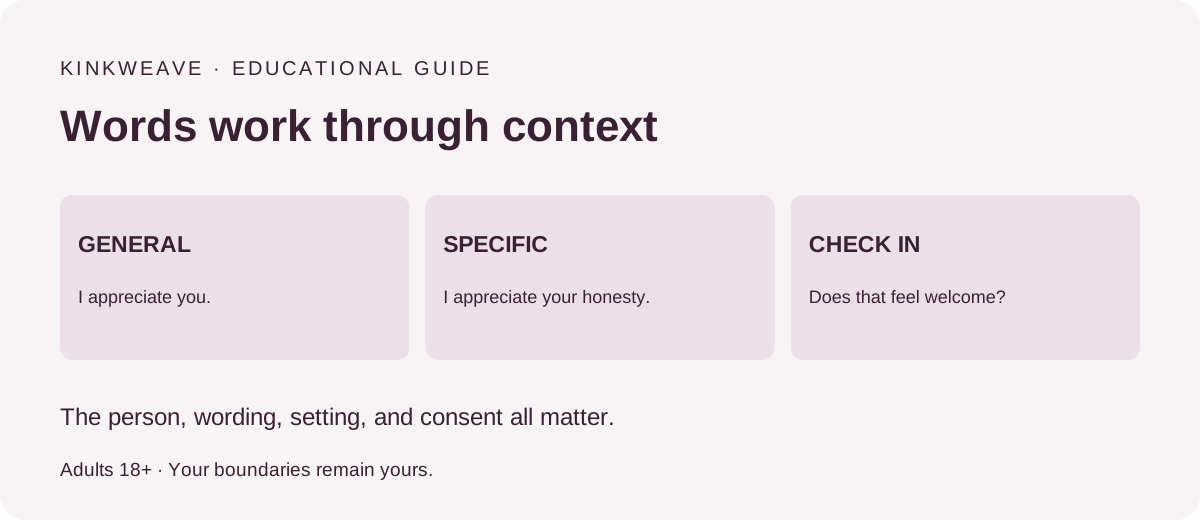
What is a praise kink?
“Praise kink” is an informal term people use to describe a particular response to affirming language.
It is not a standardized diagnosis or a personality category with a required checklist.
One adult might use it because certain compliments feel distinctly intimate. Another might enjoy offering encouragement in a mutually agreed context. Someone else may like exactly the same words without experiencing them as kinky.
The meaning comes from the person and situation, not from a phrase alone.
More than liking a compliment?
Many people appreciate being told they did something well. That ordinary enjoyment does not establish a kink.
A useful distinction is whether praise has a particular intimate significance for you beyond everyday appreciation. Even then, the label remains your choice.
You might notice that the same sentence feels ordinary from a coworker and unusually meaningful from a partner. Or you may enjoy specific praise in private while disliking broad compliments.
None of these observations needs to become a test you must pass.
Try asking:
- Is the appeal mostly affection, encouragement, arousal, or a mixture?
- Does the identity of the speaker matter?
- Does the setting change how the words feel?
- Are there words I enjoy and others I strongly dislike?
These are reflection questions, not diagnostic criteria.
The label is optional
You can say “I like affectionate encouragement” without adopting “praise kink.”
You can also use the label privately while explaining the preference in ordinary language to a partner.
The goal is not to find the most interesting name. It is to communicate what feels welcome.
If kink terminology is new to you, what is a kink? explains why interests, identity labels, and actions do not always line up.
A word is useful when it makes your meaning clearer. You are allowed to leave it behind when it does not.
Why praise can feel arousing: the psychology
The honest answer is that there is no single established explanation for everyone who uses the term “praise kink.”
Research on relationships and responsiveness can offer relevant context. It does not automatically explain this specific preference.
What relationship research can tell us
In three studies, Birnbaum and colleagues examined partner responsiveness and sexual desire. They reported an association between responsiveness and greater desire, with feeling valued among the factors considered.
This is relevant background for understanding why being understood and appreciated might matter in an intimate relationship.
However, the studies were about partner responsiveness, not a clinical category called praise kink. They do not show that a particular compliment reliably creates desire or that everyone responds the same way.
The practical implication is modest: paying attention to a partner’s actual experience may matter more than delivering a supposedly perfect line.
What the research does not establish
It does not establish that a praise kink proves low self-esteem, childhood neglect, a specific attachment style, or a particular need for approval.
Those explanations may appear frequently online, but repetition is not evidence.
A preference also does not tell you whether praise is necessary, occasional, playful, or important only in one relationship.
Avoid reducing the subject to an unsupported claim such as “your brain is addicted to validation.” That language can turn an ordinary discussion of preference into an invented diagnosis.
You do not need to identify a hidden wound before asking for language you enjoy.
If reliance on approval is causing distress in your life, that concern deserves attention on its own terms. It should not be assumed from the presence of an intimate preference.
Praise kink examples: gentle, non-graphic language
Useful praise is welcome, sincere, and suited to the person hearing it.
The following examples are conversation starters. They are not guaranteed to feel good, and none should be treated as a script that overrides feedback.
| Style | Gentle example | What to clarify |
|---|---|---|
| Appreciation | “I appreciate how clearly you told me what you wanted.” | Does specific acknowledgment feel welcome? |
| Encouragement | “You don’t have to get every word right. I’m listening.” | Does reassurance feel supportive or distracting? |
| Personal attention | “I love how thoughtful you are with me.” | Does the wording feel sincere and specific? |
| Shared enjoyment | “I really like spending this time with you.” | Is the emphasis on togetherness appealing? |
| Recognition | “That was considerate of you.” | Does being noticed matter more than being evaluated? |
| Affection | “You mean a lot to me.” | Is affectionate language welcome in this context? |
These phrases are deliberately mild. The intimate significance, if any, comes from the relationship and mutually understood context.
Appreciation
Appreciation names something real.
“I appreciate how clearly you explained that” is different from a generic “you’re amazing.” Both can be welcome, but they do different jobs.
Specific appreciation may suit someone who wants to feel seen without being placed on a pedestal.
Keep the observation accurate. Exaggeration can make language feel rehearsed, especially when the recipient knows the speaker does not mean it.
You can ask, “Do you like hearing specific things I notice, or do you prefer simple affection?”
That question often reveals more than searching for a longer collection of phrases.
Encouragement
Encouragement can communicate that someone does not need to perform perfectly.
Gentle wording might include:
“Take your time. I want to understand.”
Or:
“I’m glad you told me what works for you.”
Encouragement should make choices easier to express. It should not reward someone for overlooking discomfort.
For example, praising honesty after a person sets a boundary can acknowledge their communication. Praising them for “pushing through” an unwanted experience risks sending the opposite message.
The relevant question is not simply whether the words sound positive. It is what behavior the conversation is encouraging.
Personal attention
Some people care less about an adjective and more about the feeling that a partner has noticed them accurately.
“I love how you bring humor into our conversations” may feel more personal than a broad statement about being perfect.
Others prefer simple language and find detailed praise uncomfortable. They may enjoy warmth without wanting an analysis of their qualities.
Neither response is wrong.
Ask what feels natural, and allow the answer to change across settings. A phrase that feels welcome in private may feel embarrassing at dinner with friends.
Praise kink vs. words of affirmation
“Words of affirmation” commonly describes a preference for verbal expressions of affection, appreciation, and support.
A praise kink describes a more specifically intimate or arousing significance that praise may have for someone.
There can be overlap without the two being identical.
| Dimension | Praise kink | Words of affirmation |
|---|---|---|
| Typical emphasis | Intimate or arousing meaning attached to praise | Feeling appreciated or cared for through words |
| Does it require a power dynamic? | No | No |
| Does it require a kink identity? | No | No |
| Can ordinary compliments be involved? | Yes, depending on context | Yes |
| Does the term prove a psychological cause? | No | No |
| Most useful question | “What kind of praise feels intimate to you?” | “What words help you feel appreciated?” |
Neither label tells a partner exactly what to say.
You may like affirming language throughout the day and have no interest in a praise kink. You may also enjoy praise in a particular intimate context while preferring less verbal reassurance elsewhere.
It is usually more useful to describe these differences than to determine which label wins.
Avoid turning words of affirmation into a fixed prescription. A person can appreciate more than one form of care, and preferences can vary with circumstances.
Does a praise kink mean you are submissive?
No. Enjoying praise does not establish a submissive role.
Praise may occur between equals, within an agreed power dynamic, or without any BDSM context.
Someone who enjoys leading can also enjoy encouragement. Someone who enjoys following can dislike praise. The combination cannot be inferred from either label.
If praise becomes part of BDSM participation, it belongs within explicit consent, agreed boundaries, a safeword or stop signal, and an SSC or RACK framework. Words should not become a way to bypass a person’s ability to decline.
Interest in praise also says nothing about interest in consensual non-consent. The CNC kink meaning guide addresses that separate concept and its consent requirements.
A useful boundary might be:
“I like encouraging words, but I don’t want them connected to obedience or a role.”
Another person may welcome role-specific language. That is something to agree on, not assume.
How to bring it up with a partner
You do not need to begin with the term “kink” if that makes the conversation feel more complicated than it needs to be.
Start with a preference that the other person can understand.
Start with one concrete preference
Try:
“I really liked when you told me you appreciated me. I’d enjoy hearing that kind of thing more often.”
Or:
“Certain encouraging words feel especially intimate to me. Would you be comfortable talking about that?”
These statements explain the appeal without demanding an immediate performance.
Choose a relaxed time rather than testing a new phrase in the middle of an emotionally loaded moment.
The partner giving praise also has preferences. They may want wording that feels natural, time to think, or reassurance that they do not need to memorize lines.
A shared vocabulary should be comfortable for both people.
Talk about words you do not want
Dislikes can be as useful as examples.
A person may dislike language that feels parental, gendered, infantilizing, possessive, evaluative, or exaggerated.
Do not assume that a widely circulated phrase is welcome just because other people enjoy it.
You might say:
“I like appreciation, but I don’t like being graded.”
Or:
“Please use my name rather than a nickname.”
These are ordinary communication preferences. They do not require defending.
If one person likes a phrase the other cannot offer sincerely, find different wording or leave it out. Authenticity matters more than completing a script.
Make feedback easy
After a conversation, ask a small, answerable question.
“How did that wording feel?” is easier to respond to than “Was that perfect?”
Offer room for mixed feedback: “I liked the warmth, but that particular word wasn’t for me.”
Receiving feedback well is part of making future feedback possible. Avoid responding as though a correction means you failed or the other person is impossible to please.
A phrase can be almost right and still need changing.
The goal is better understanding, not a flawless first attempt.
When praise starts to feel like pressure
Positive wording can still create pressure if it is tied to compliance.
Notice the difference between “I appreciate your honesty” and “You’re so good when you don’t argue with me.”
The issue is not whether the speaker used a pleasant tone. It is whether the message leaves the other person free to disagree.
Be cautious when approval is offered only after boundaries are relaxed, or when affection is withdrawn after a refusal.
A useful self-check is: “Can I say no without losing basic kindness?”
If the answer is uncertain, pause and discuss that concern before focusing on better praise phrases.
No preference requires accepting a pattern that makes you feel controlled or unable to speak.
Likewise, receiving praise should not create a debt. A compliment does not require intimacy, gratitude performed on demand, or agreement to a new request.
You are allowed to enjoy the words and still decline everything else.
Privacy, messages, and public compliments
The setting can change the meaning of praise.
A private phrase may feel welcome in a conversation and uncomfortable in a public comment. A message may also appear on a lock screen or be seen by someone other than the intended recipient.
Ask whether intimate wording belongs in messages at all, and whether there are contexts where ordinary affectionate language is preferable.
Do not share screenshots without permission.
If a couple uses praise within a negotiated dynamic, outsiders should not be involuntarily drawn into that dynamic. Keep public communication within boundaries everyone involved has agreed to.
It is also reasonable to distinguish everyday affection from intimate language. Someone may want frequent ordinary appreciation while reserving certain wording for private situations.
That distinction protects clarity without making affection complicated.
Finding your own language
You do not need a hundred examples. A few words that fit your relationship are more useful than a large collection of borrowed lines.
Try making three short notes:
- A phrase or kind of praise I already enjoy.
- A word or tone I would rather avoid.
- A context where the preference feels welcome.
You can keep those notes private or use them to start a conversation.
If you are unsure whether praise is the main theme, explore different types of kinks. You may find that what appeals is connection, predictability, or attention more broadly.
KinkWeave’s kink list of preference themes offers another way to find descriptive language.
The kink test can support reflection, but it cannot diagnose a praise kink or tell a partner which words to use.
Your own response is the relevant information.
You might settle on a label. You might simply say, “I like knowing what you appreciate about me.” Either can lead to a clear, warm conversation.
There is no need to turn a welcome preference into a performance requirement. Leave room for ordinary affection, imperfect wording, and honest feedback.
Frequently asked questions
Does liking compliments mean I have a praise kink?
No. Enjoying compliments alone does not establish a praise kink. The term usually describes praise with particular intimate or arousing significance, and using the label is optional.
Is a praise kink caused by low self-esteem?
The preference alone cannot establish its cause or someone’s self-esteem. Claims about a specific psychological origin require evidence beyond a label.
Can a praise kink exist without BDSM?
Yes. Praise can have intimate significance without a power dynamic, roleplay, or other BDSM interests. Partners should still discuss what language is welcome.