CNC Kink Meaning: Understanding Consensual Non-Consent
Adults 18+ · Educational content, not medical or psychological advice
By KinkWeave Editorial ·
CNC means consensual non-consent: an adult kink term for an explicitly agreed fictional scenario that may portray a lack of consent while actual consent remains necessary and withdrawable. It does not mean permission to ignore someone’s real wishes. Understanding the CNC kink meaning starts with that distinction: the fiction can involve resistance; the agreement underneath it cannot disappear.
If you encountered the term in a conversation, a dating profile, or fiction, you do not need to decide how you feel about it immediately. Learning a definition is enough.
This guide explains the vocabulary, the importance of boundaries, and the limits of safety frameworks. It does not provide instructions for staging a scenario.
What does CNC mean?
In kink discussions, CNC expands to consensual non-consent. People sometimes use the term differently, which makes it especially important to ask what someone means instead of assuming that a shared label creates a shared understanding.
For this guide, the term refers to negotiated adult roleplay with continuing, revocable consent. Any interpretation that makes withdrawal impossible falls outside that definition.
Consent to a fictional situation
Consider the difference between a character and the person portraying that character. A fictional role does not erase the person’s preferences, limitations, or ability to stop participating.
That distinction is central to CNC. Agreement concerns a defined scenario, with boundaries that remain real even when the scenario is fictional. It is not agreement to anything a partner might improvise.
“Consensual” is therefore not a decorative word added to make the concept sound acceptable. It describes a condition that must remain true.
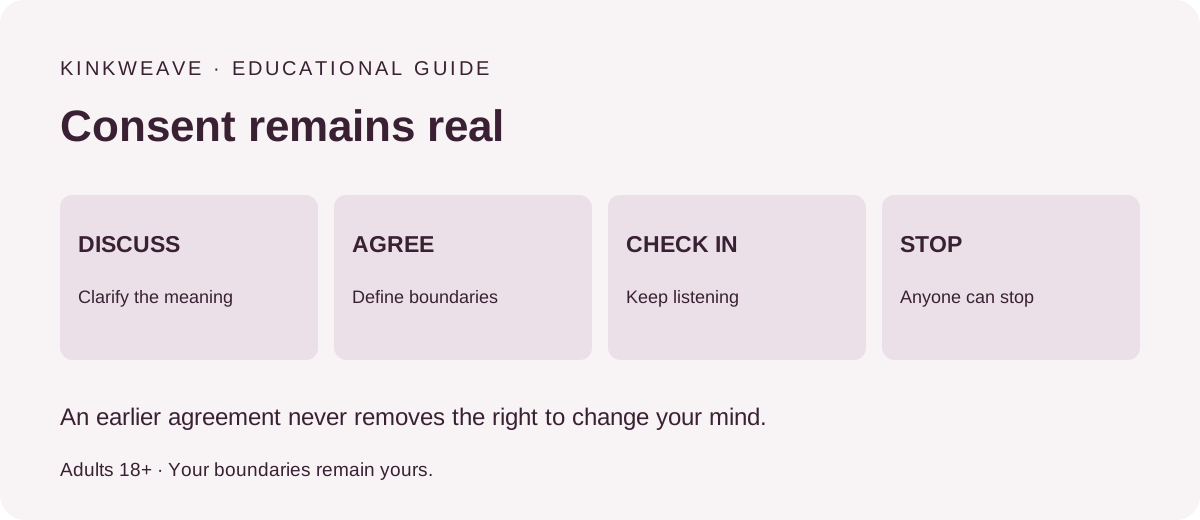
If someone no longer wants to participate, the original agreement does not overrule that change. Continuing because “you agreed earlier” would contradict the consent framework this article uses.
A fantasy is not permission
Someone can find an idea interesting in fiction and have no interest in experiencing it. They can also enjoy discussing a topic without wanting to rehearse, schedule, or act on it.
A useful conversation separates three different statements:
- “I am curious about this idea.”
- “I might want to discuss whether it fits me.”
- “I agree to this specific interaction under these specific conditions.”
Only the third statement concerns an actual agreement, and it still remains revocable.
Reading an article, identifying with a label, or receiving a quiz result establishes none of those conditions for another person. Curiosity belongs to the individual; permission must be communicated.
CNC in kink vs. CNC in other contexts
If you searched “what does CNC mean,” the answer depends on the setting.
| Context | Common meaning | What the surrounding language usually concerns |
|---|---|---|
| Adult kink discussion | Consensual non-consent | Negotiation, roleplay, boundaries, consent |
| Manufacturing | Computer numerical control | Machines, machining, programming, production |
| A profile or private message | Potentially the kink meaning, but not certain | Ask the writer rather than assuming |
| An unfamiliar acronym list | Meaning depends on the field | Check the source and context |
Even within an adult conversation, the acronym alone is insufficient. One person may be referring to a fictional theme; another may be describing a relationship arrangement.
Neither interpretation tells you what the person would welcome, what is excluded, or whether they want to discuss participation at all.
A straightforward clarification works well: “When you use CNC, what does that mean to you?” The answer should lead to clearer language, not substitute for it.
How CNC works in practice: negotiation and safewords
Any discussion of BDSM participation should begin with explicit consent, an agreed safeword or stop signal, and a framework such as SSC or RACK. Those foundations help structure decisions; they do not make an activity automatically safe.
The National Coalition for Sexual Freedom’s sample consent policy emphasizes advance agreement, discussion of risks, and the ability to withdraw consent. It also advises against expanding an agreement during a scene.
Define the boundaries before discussing participation
A label describes a topic. A boundary describes what is and is not welcome.
Before anyone considers participating, a discussion would need to distinguish the permitted scope from excluded situations, language, settings, and interactions. “We trust each other” does not answer those questions.
A useful clarification is to ask each person to explain the proposed agreement in their own words. If the explanations differ, there is not yet a shared plan.
Keep “not sure” separate from “yes.” Uncertainty is information that calls for a pause, not an invitation for someone else to supply the answer.
No amount of preparation creates a duty to proceed. A conversation can end with a clearer understanding and no activity planned.
Make stopping unmistakable
A safeword is a previously agreed signal to pause or stop. A nonverbal signal may also be needed, but it must be usable and recognizable in the actual circumstances.
Choosing a word is only one part of the agreement. Everyone must understand what happens when it is used: the interaction stops, the fictional roles end, and attention returns to the person’s immediate needs.
The signal must never become a test of endurance or a reason for criticism. No one should need to justify using it before it is honored.
For readers new to the topic, ordinary “no” and “stop” should remain stop instructions. Do not experiment with making refusal ambiguous. If it is unclear whether someone is still willing, stop and clarify.
Plan for uncertainty, not just agreement
Consent cannot be reduced to listening for one exact word. A person may become quiet, confused, unable to communicate clearly, or visibly distressed.
RAINN explains that consent is ongoing and voluntary, and that silence or lack of resistance is not agreement. Its consent guidance is useful background for any intimate conversation.
A responsible agreement therefore includes a simple default: uncertainty means pause.
Do not treat a missed signal as evidence that everything is fine. Do not ask someone to demonstrate distress convincingly enough to earn a stop. A communication plan should reduce ambiguity, not give anyone a technical excuse to overlook it.
Safety framework: SSC vs. RACK
Two acronyms appear frequently in BDSM education: SSC, meaning safe, sane, and consensual, and RACK, meaning risk-aware consensual kink. These are community frameworks, not medical certifications or guarantees. See the terminology overview in Consent in BDSM.
| Framework | Main emphasis | Useful question | Important limitation |
|---|---|---|---|
| SSC | Safety, capacity for informed decisions, and consent | “Can everyone make a clear decision, and have foreseeable hazards been considered?” | Calling something safe does not remove its risks |
| RACK | Understanding risks and making an informed, voluntary choice | “What could go wrong, and what remains uncertain?” | Accepting risk does not authorize boundary violations |
| Both | Consent as an essential condition | “Can anyone stop, freely and immediately?” | Neither acronym replaces knowledge, communication, or judgment |
The word “sane” is part of the historical SSC phrase. It should not be used to insult people, diagnose a partner, or suggest that a mental health label determines someone’s worth.
For practical decision-making, focus on whether each person can understand the agreement, communicate a choice, and change that choice freely.
RACK can make uncertainty more visible, but it should never become “you accepted the risk, so you cannot object.” Consent to one interaction is not acceptance of every possible action.
For CNC discussions in particular, the possibility of misreading communication deserves serious attention. Neither framework can resolve that problem merely by being named.
Questions that matter before any decision
A useful discussion is less about sounding knowledgeable and more about making disagreement easy.
The following questions are reflection prompts, not a checklist that certifies readiness. Passing through them does not establish that a scenario is appropriate.
Can everyone decline without consequences?
Imagine the answer is “no,” “not today,” or “I changed my mind.”
Would that answer lead to an ordinary, respectful conversation? Or would someone become cold, threatening, mocking, or persistent?
A choice is not freely made when affection, relationship security, or acceptance is being used as leverage.
Pay particular attention to statements such as “you would do this if you trusted me.” Trust is not demonstrated by abandoning a boundary. A more useful sign of trust is that someone can state a boundary and expect it to be respected.
The same standard applies to the person being asked to take a leading role. Nobody owes participation from either side.
Is the agreement specific enough?
“I’m open-minded” is not a defined agreement. Neither is “I like surrender,” “I enjoy intense fiction,” or “we have done something similar before.”
Ask what is included, what is excluded, and which decisions remain undecided. Discuss privacy as part of the scope: talking about an interest does not authorize screenshots, recordings, or disclosure to friends.
A written note can help people remember a conversation, but it is not a permanent waiver. Its purpose is clarity, not enforcement against someone who has changed their mind.
If explaining the agreement requires repeated exceptions to the right to stop, the conversation needs to pause.
What happens afterward?
Aftercare means whatever mutually agreed support people want after an interaction. It might involve conversation, quiet, space, or a later check-in. There is no single emotional response everyone must have.
Discuss preferences without assuming that touch or closeness will always be welcome.
It is also useful to separate immediate support from later reflection. Someone may want practical comfort first and words later.
Aftercare cannot retroactively create consent, excuse a crossed boundary, or make an unwanted interaction acceptable. An apology and a supportive gesture do not replace accountability.
The NCSF negotiation guide offers a broader set of topics for structured consent conversations.
Common misconceptions about CNC
“CNC means consent is given away.” That is not the framework used here. The person retains the right to stop, change their mind, and reject something outside the agreement.
“It is a more advanced or superior form of intimacy.” There is no ladder of relationship achievement that ends in CNC. A couple can have a thoughtful, trusting relationship without any interest in it.
“A submissive role means agreeing to whatever happens.” A role is not unlimited permission. It does not determine what someone wants outside the agreed context, either.
“A safeword makes the situation safe.” A signal is useful only if it can be communicated, recognized, and honored. It does not prevent every misunderstanding or harm.
“Being interested proves something about someone’s history.” An interest alone does not establish a cause, a diagnosis, or a personal history. Do not use a label to speculate about another person’s experiences.
“A partner should participate to avoid being judgmental.” Respecting an interest and sharing that interest are different things. A warm, clear refusal can be entirely respectful.
These distinctions also apply to less intense topics. For example, enjoying a praise kink does not establish interest in power exchange or CNC.
How to discuss curiosity without committing
Choose a time when neither person is already expecting an intimate interaction. Ask whether the topic is welcome before explaining it.
You might say:
“I came across the term consensual non-consent. I’m interested in understanding it, but I’m not asking to try anything. Would you be comfortable talking about the concept?”
This separates education from a proposal.
If the conversation continues, describe the aspect you are curious about without treating the label as self-explanatory. You might be interested in fictional storytelling, agreed roles, or the meaning of surrender. Those are different subjects.
The other person can respond with curiosity, uncertainty, or disinterest. None requires an immediate decision.
You can also keep the discussion entirely hypothetical. There is no deadline for deciding whether a word belongs in your life.
If basic terminology is still unfamiliar, start with what a kink is. Understanding the broader vocabulary can make a specific term less confusing.
When to pause the conversation
Pause if someone dismisses the need for boundaries, treats questions as an insult, or insists that genuine trust makes safeguards unnecessary.
Also pause if you find yourself agreeing mainly to prevent conflict. A useful question is: “Would I still choose this if declining had no effect on how this person treated me?”
You do not need a perfect explanation for discomfort. “I do not want this” is a complete boundary.
If a discussion brings up distress, you can stop reading, change the subject, or seek support from a qualified professional who respects consensual adult sexuality. The goal of support should be your well-being, not pressure to accept an identity or participate.
If someone has ignored your consent, the label they used does not erase what happened. RAINN provides confidential support options for people seeking help.
Explore the vocabulary at your own pace
You do not need to adopt a label because you understand it. You can be curious, undecided, uninterested, or interested only in fiction.
For broader language, explore KinkWeave’s kink list of preference themes. It introduces ways to describe interests without prescribing activities.
The kink test offers a different kind of reflection. It is not a CNC assessment and cannot establish readiness, consent skills, or compatibility.
A useful result from reading this article may be just one sentence: “I understand the term, and I know that actual consent must remain clear.”
That is a complete outcome.
Frequently asked questions
What does CNC mean in a relationship?
CNC means consensual non-consent. In this guide, it describes negotiated adult roleplay with explicit, ongoing consent. It never gives a partner unlimited permission.
Can someone withdraw consent during CNC?
Yes. Anyone can withdraw consent at any time. A safeword is one agreed signal, but clear withdrawal or uncertainty also requires stopping.
Does a CNC fantasy mean someone wants real assault?
No. A fantasy does not establish a wish to experience real assault, and it never gives another person permission to act.