Rice Purity Test Score Meaning: A Judgment-Free Guide
Adults 18+ · Educational content, not medical or psychological advice
By KinkWeave Editorial ·
Your Rice Purity Test score counts how many listed experiences you marked “Yes.” On a fully answered 100-item test, a higher score means fewer listed experiences and a lower score means more. The number does not measure your goodness, maturity, relationship value, health, or personal boundaries.
That is the most useful Rice Purity Test score meaning to keep in mind before looking at a chart.
If you searched your result because it made you anxious, there is no score you need to defend. The test’s historical “purity” label does not turn a checklist into a moral assessment.
You can take the Rice Purity Test when you feel comfortable, or use this guide to understand a result you already have.
What your Rice Purity Test score means
A score summarizes answers to a particular set of questions. It does not summarize your entire life.
That distinction matters because the checklist combines different kinds of experiences. Some concern relationships, some concern substances, and some concern illegal or harmful situations. Giving every “Yes” the same numerical weight does not make those experiences equivalent.
Nor does the total show whether an experience was wanted, enjoyable, regretted, repeated, or relevant to your life now.
Think of the result as an answer count with a historical name attached. The arithmetic is precise; the broader personality story people sometimes build around it is not.
How the score is calculated
For a fully answered 100-item edition:
Score = 100 − number of “Yes” answers
For example:
- 10 “Yes” answers produce a score of 90.
- 35 “Yes” answers produce a score of 65.
- 60 “Yes” answers produce a score of 40.
These are arithmetic examples, not averages or recommended outcomes.
A score of 65 also does not mean you are “65% pure.” There is no measurable substance called purity being assessed, and the score is not a percentile ranking against other adults.
It means 35 items were marked “Yes” in that particular completed edition.
What happens when you skip a question
KinkWeave does not treat skipped or unanswered questions as automatic “No” answers. Unresolved items leave a possible score range rather than a final score.
For example, suppose you have:
- 25 “Yes” answers;
- 70 “No” answers;
- 5 unresolved items.
Your possible range is 70–75. It would be 75 if all five remaining answers were “No,” or 70 if all five were “Yes.”
Those endpoints are possibilities, not two competing final results.
The current edition also preserves an unspecified question shown as “?” at item 69. You do not need to invent a meaning for it. Leaving it unresolved leaves the result incomplete. See the tool’s Rice Purity Test scoring explanation for its version notes.
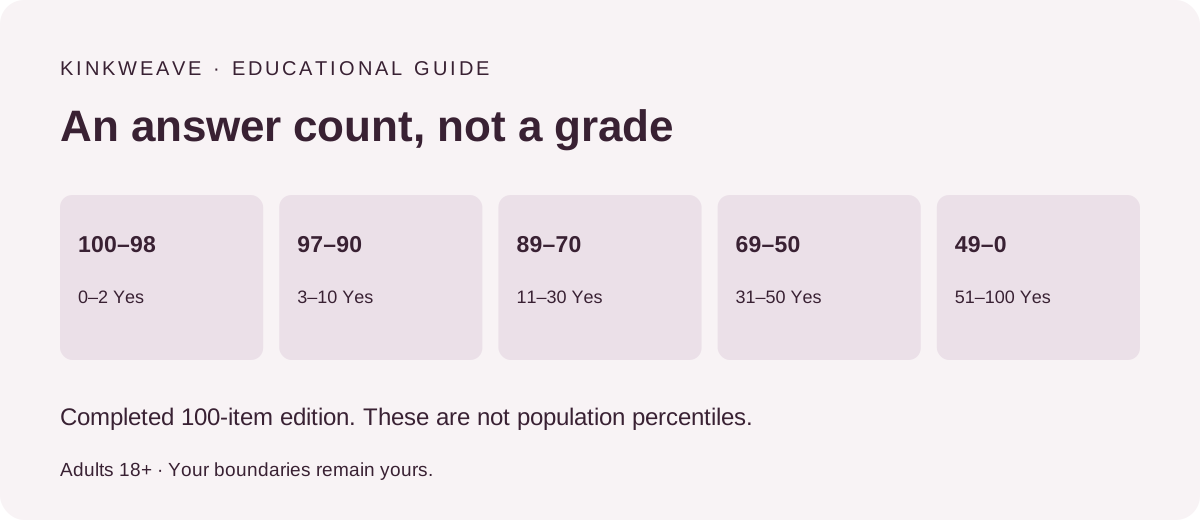
Rice Purity Test score chart: 0–100
The following bands are editorial reading aids. They are not validated psychological categories, age expectations, or population percentiles.
| Score range | “Yes” answers on a completed 100-item test | Neutral interpretation |
|---|---|---|
| 100–98 | 0–2 | You marked very few of this edition’s listed experiences |
| 97–90 | 3–10 | You marked a small number of listed experiences |
| 89–70 | 11–30 | You marked between 11 and 30 listed experiences |
| 69–50 | 31–50 | You marked roughly one-third to one-half of the items |
| 49–0 | 51–100 | You marked more than half of the listed experiences |
The chart deliberately avoids labels such as “innocent,” “wild,” or “corrupted.” Those descriptions add judgments that the arithmetic cannot support.
Scores of 100–98
This range means zero, one, or two “Yes” answers.
It does not tell us why. A person may have chosen not to pursue the listed experiences, may not relate to the questions, or may simply have a different history from the one the checklist emphasizes.
There is no obligation to lower the number. A high score is not evidence that you are behind, sheltered, or missing a required stage of adulthood.
The appropriate question is whether your choices fit your circumstances and values, not whether they produce a more interesting result.
Scores of 97–90
This range represents three to ten “Yes” answers.
Avoid converting that count into an assumption about relationship skill. Knowing how to listen, communicate, and respect another person cannot be read from this band.
Likewise, a person in this range does not owe anyone an explanation for experiences they have not had.
If the number feels unexpectedly high, check whether you answered the edition you intended to take. Different wording can change how a person interprets an item.
Scores of 89–70
This range represents eleven to thirty “Yes” answers.
Someone may see it described online as a particular “stage” of experience. That framing is more confident than the test allows.
There is no universal sequence in which adults accumulate the listed experiences. A relationship may correspond to several questions, while other important life experiences may not appear anywhere on the checklist.
Your result therefore reflects the questionnaire’s selection of items as well as your answers.
Scores of 69–50
This range represents thirty-one to fifty “Yes” answers.
It is tempting to describe the middle of the scale as “average.” But the numerical midpoint of a test is not the same as the average of a measured population.
A score of 50 simply means half the items were marked “Yes.” It does not place you at the middle of the adult population.
Nor does this range establish balance, responsibility, or risk. Those require context the total does not contain.
Scores of 49–0
This range represents fifty-one to one hundred “Yes” answers.
A low score does not mean you are damaged, undesirable, or less worthy of respect. It also does not certify confidence, sophistication, or relationship experience.
The band is especially broad: a score of 49 and a score of 9 represent very different answer counts. Neither total reveals the person’s circumstances.
If a particular memory raises a concern, focus on that specific experience and the support you want now. The overall number cannot tell you what happened or what you need.
What is the average Rice Purity Test score?
There is no verified, nationally representative U.S. adult average established by the sources used for this guide.
Public internet surveys can provide examples of what one group reported. They should not be presented as the score an adult is supposed to have.
One public survey, with important limitations
A 2021 r/SampleSize survey report published these results:
| Statistic | Reported value | What it describes |
|---|---|---|
| Mean | 55.56 | The arithmetic average in that respondent group |
| Median | 51 | The middle reported score |
| 25th percentile | 36 | The lower boundary of the middle half |
| 75th percentile | 81 | The upper boundary of the middle half |
| Middle 50% interval | 36–81 | The interval between the two reported quartiles |
The organizer explicitly warned that the sample was not representative. The report also disclosed under-18 responses despite intending adult recruitment. It was an informal, self-selected internet survey, not an adult-only U.S. population study; the posted summary does not establish a verified denominator for every statistic.
The interval 36–81 is an interquartile range, not an “average range” or a recommended band. These figures illustrate one sample only and cannot establish current national norms.
Why an online average is not a personal benchmark
Before accepting any average, ask who supplied the answers.
Visitors to a particular website may differ from people in a university survey, a social community, or the general population. People who voluntarily share a result may also differ from people who prefer not to share.
Next, ask whether all respondents answered the same questions. An average across different editions mixes measurements that may not be directly comparable.
Finally, check whether repeated attempts, incomplete tests, and joke responses were handled. A large submission count is not automatically a large count of unique people.
You do not need advanced statistics to recognize the central problem: a precise-looking number can still describe the wrong comparison group.
What is a good Rice Purity Test score?
There is no universally good score.
If “good” means morally better, the test cannot answer that question. If it means healthy, compatible, or emotionally ready for a relationship, it cannot answer those questions either.
A more useful goal is a result you understand accurately, if you choose to complete the test at all.
That means knowing which edition you answered, distinguishing a final score from an incomplete range, and resisting pressure to change your life for a number.
You can prefer a quiet life, enjoy new experiences, have a complicated history, or feel uncertain about parts of your past. None of those possibilities turns a score into a verdict.
There is also no benefit to aiming for zero. The questionnaire includes harmful and illegal experiences; it must never become a bucket list or challenge.
How to interpret your results without judgment
Start by translating the result back into its literal meaning.
Instead of “I scored badly,” try: “I marked this many items in this edition.”
Then separate what the score actually tells you from what you are adding to it.
For example:
| Reaction | More accurate interpretation |
|---|---|
| “My score proves I am boring” | “This checklist includes experiences I have not marked” |
| “My score makes me less worthy” | “A count cannot measure my worth” |
| “My partner will know everything” | “The total does not reveal my complete history” |
| “I need to change the number” | “The number creates no obligation” |
If the result brings up embarrassment, ask whose expectations you are measuring yourself against. A friend group’s joking labels do not create an objective standard.
You may also decide the test is not useful for you. Closing it, leaving questions unanswered, or choosing not to share is a reasonable response.
Reflection does not require completing every question.
Why two people can have the same score and different histories
Imagine two fictional adults who each score 75.
Both marked 25 items “Yes.” That is the only shared fact the number establishes.
They may have selected different items, interpreted ambiguous wording differently, or had very different feelings about the experiences they marked.
Even identical answer patterns would not tell us whether their experiences happened recently, happened once, or carry the same personal meaning.
This is why a Rice Purity result cannot substitute for a conversation about current preferences.
Past experience also does not create present consent. Having done something before does not mean someone enjoyed it, wants to repeat it, or wants to discuss it.
The reverse is equally important: not having done something does not reveal whether someone is curious, uninterested, or simply private.
Comparing results with a partner or friends
Sharing can be optional and lighthearted, but it should remain optional.
Before comparing scores, agree that nobody has to reveal answers or explain a result. Avoid turning the difference between two numbers into a competition.
A simple boundary might be:
“I’m comfortable sharing the total, but I’m not going through individual questions.”
Or:
“I’d rather talk about what matters to us now than compare histories.”
If you are discussing relationship compatibility, ask direct questions about present expectations, communication, exclusivity if relevant, and privacy. A numerical gap does not answer any of them.
Do not screenshot or redistribute another person’s result without permission.
Even a total can feel personal, and a person who shared it with one audience has not agreed to share it with everyone.
Is a Rice Purity score the same as a kink score?
No. An experience checklist and a preference questionnaire ask different questions.
A Rice Purity result counts listed experiences. It cannot determine whether someone enjoys a particular theme, identifies as kinky, or wants to explore anything new.
KinkWeave’s kink test is intended for reflecting on preferences rather than counting past experiences. Neither kind of result is a diagnosis or a consent agreement.
If you are new to the vocabulary, what is a kink? explains the distinction between an interest, an identity, and an action.
For example, reading about a praise kink may help you describe a preference for certain kinds of affirming language. Your Rice Purity score would not establish that preference.
Before you take or retake the test
Give yourself permission to stop before you begin.
Choose a setting where you are not being watched, rushed, or pressured to explain your answers. Read the version notes if you intend to compare results.
If a question is unclear or uncomfortable, skipping is preferable to inventing an answer for the sake of completion. An incomplete range can be an honest representation of what you chose to disclose.
When retaking the test, a changed result does not necessarily mean your life changed. You may remember an experience differently, interpret wording differently, or be using another edition.
Use the Rice Purity Test results and scoring guide to check the arithmetic before attaching meaning to a change.
Most importantly, keep the direction of influence clear: your choices determine your answers. A score should not determine your choices.
Frequently asked questions
Is a low Rice Purity Test score bad?
No. A lower score means more listed experiences were marked “Yes.” It does not measure your worth, character, health, or suitability as a partner.
Is 100 the best Rice Purity Test score?
No score is best. On a completed 100-item test, 100 means every answer was “No.” It is an answer count, not a grade.
Can I get a final score if I skip questions?
On KinkWeave, skipped or unanswered items produce a possible range instead of a final score. A final score requires an explicit answer to every item.